
Core Web Vitals Optimization Services
Improve Website Speed, User Experience & Technical SEO Performance
A website can look professional and still perform poorly if pages load slowly, respond late, or move unexpectedly while visitors are using them.
I provide professional Core Web Vitals Optimization Services to help businesses improve website performance, responsiveness, visual stability, and overall user experience.
I also analyze related performance issues involving:
- Website speed
- Mobile performance
- Images
- JavaScript
- CSS
- Fonts
- Server response
- Caching
- Third-party scripts
- WordPress
- Shopify
- WooCommerce
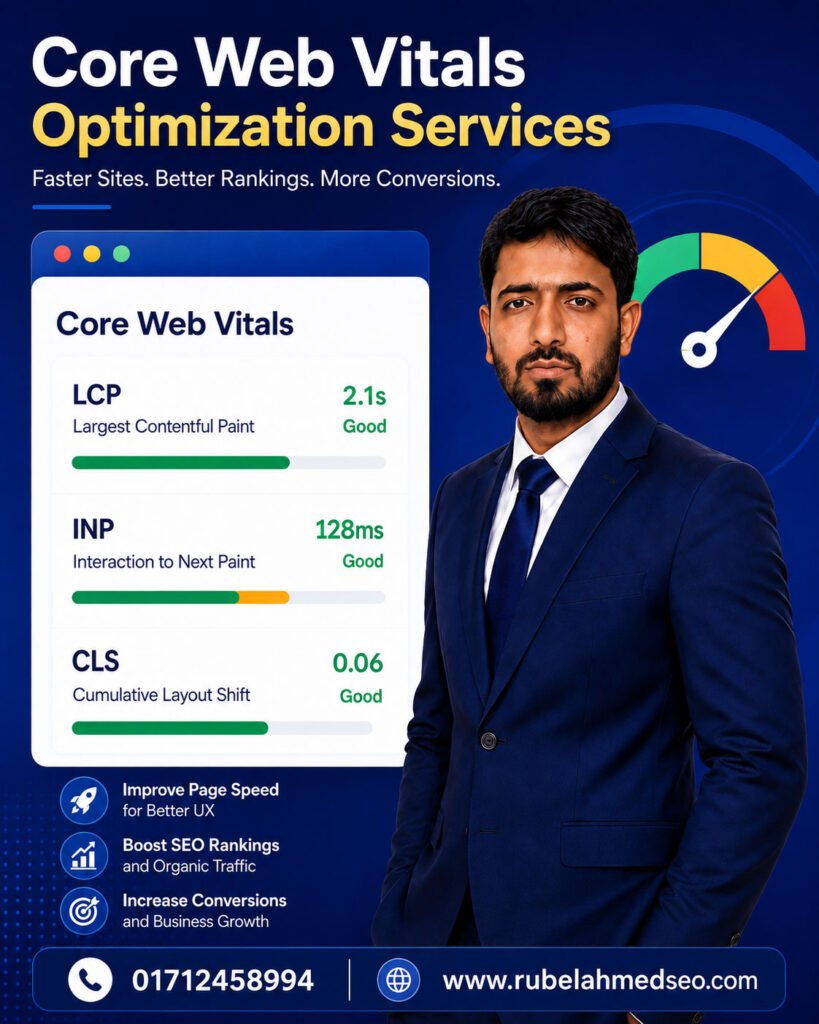
What Are Core Web Vitals?
Core Web Vitals are website performance metrics used to measure important aspects of real-world user experience.
They focus on three areas:
Loading Performance
How quickly important page content becomes visible.
Responsiveness
How quickly the website reacts after a visitor interacts with it.
Visual Stability
How stable the page remains while loading and being used.
The current Core Web Vitals metrics are:
LCP → Loading
INP → Responsiveness
CLS → Visual Stability
Improving these metrics can create a better experience for both desktop and mobile visitors.
Why Are Core Web Vitals Important?
Users expect modern websites to load and respond quickly.
Poor performance can make visitors:
- Leave the page
- Abandon forms
- Stop browsing products
- Avoid completing purchases
- Lose confidence in the website
Core Web Vitals help identify performance issues that affect real user experiences.
Improving them can support:
Faster Page Loading: Visitors reach important content more quickly.
Better Mobile Experience: Mobile users often experience slower networks and less powerful devices.
Smoother Interactions: Buttons, menus, forms, and other interactive elements respond more efficiently.
More Stable Pages: Users are less likely to click the wrong element because content suddenly moves.
Stronger Technical SEO Foundation: Core Web Vitals can form part of a broader technical SEO and page experience strategy.
What is Largest Contentful Paint (LCP)?
Improve How Quickly Main Content Loads
Largest Contentful Paint measures how quickly the largest visible content element appears on the screen.
This may include:
- Hero image
- Large banner
- Main heading
- Product image
- Featured content block
A good target for LCP is generally:
2.5 Seconds or Less
Common causes of poor LCP include:
- Large images
- Slow hosting
- Slow server response
- Render-blocking CSS
- JavaScript
- Poor resource loading
- Third-party scripts
- Heavy page builders
My LCP optimization process identifies the real cause before recommending a fix
What is Interaction to Next Paint (INP)?
Improve Website Responsiveness
Interaction to Next Paint measures how quickly your website responds after a user interacts with it.
Interactions can include:
- Clicking a button
- Opening a menu
- Selecting a product
- Using filters
- Submitting a form
- Clicking navigation
- Expanding an accordion
A good INP target is:
200 Milliseconds or Less
Poor INP is often associated with:
- Heavy JavaScript
- Long browser tasks
- Third-party scripts
- Complex page elements
- Large DOM structures
- Slow event handlers
INP optimization focuses on making important interactions feel faster and smoother.
What is Cumulative Layout Shift (CLS)?
Keep Your Website Visually Stable
Cumulative Layout Shift measures unexpected movement of page elements.
Examples include:
- Text moving after loading
- Buttons changing position
- Images pushing content downward
- Ads appearing suddenly
- Fonts changing page dimensions
- Cookie banners moving content
A good CLS score is:
0.1 or Less
Common CLS fixes may include:
- Adding image dimensions
- Reserving space for videos
- Stabilizing banners
- Improving font loading
- Managing dynamic content
- Preventing unexpected layout changes
A stable website helps users interact with content more confidently.
Main Services Section
My Core Web Vitals Optimization Services
Complete Website Performance Analysis & Optimization
I analyze your website to identify the performance issues affecting important pages.
The audit may include:
- LCP
- INP
- CLS
- Mobile performance
- Desktop performance
- PageSpeed Insights
- Rendering
- Images
- JavaScript
- CSS
- Fonts
- Server response
- Third-party resource
Improve Important Content Loading
LCP optimization may include:
- Hero image optimization
- Image compression
- WebP or AVIF implementation
- Resource prioritization
- Preloading critical assets
- Reducing render-blocking resources
- Improving server response
- Improving caching
- CDN recommendations
The objective is to make important above-the-fold content appear faster.
INP Optimization
Improve Interaction Performance
I investigate what is delaying user interactions.
Optimization may include:
- Reducing unnecessary JavaScript
- Breaking up long tasks
- Improving event handlers
- Delaying non-critical scripts
- Reducing third-party script impact
- Simplifying heavy page elements
- Improving browser workload
The goal is to make important actions respond faster.
Reduce Unexpected Page Movement
CLS optimization may include:
- Image dimension fixes
- Video container sizing
- Font optimization
- Banner stabilization
- Dynamic content control
- Ad space reservation
- Animation review
- Lazy-loading improvements
This creates a more stable user experience.
Images are often one of the biggest causes of slow page loading.
I review:
- File size
- Image dimensions
- Compression
- Image formats
- Responsive images
- Lazy loading
- Hero images
- Product image
- AVIF
- Compression
- Correct sizing
- Responsive delivery
- Lazy loading
- Priority loading
JavaScript Optimization
Too much JavaScript can affect both loading and responsiveness.
I review:
- Theme scripts
- Plugins
- Third-party scripts
- Analytics
- Chat widgets
- Tracking tools
- Marketing scripts
- Unused JavaScript
Potential improvements include:
- Deferring scripts
- Delaying non-critical JavaScript
- Removing unnecessary scripts
- Reducing execution time
- Improving loading order
JavaScript Optimization
Too much JavaScript can affect both loading and responsiveness.
I review:
- Theme scripts
- Plugins
- Third-party scripts
- Analytics
- Chat widgets
- Tracking tools
- Marketing scripts
- Unused JavaScript
Potential improvements include:
- Deferring scripts
- Delaying non-critical JavaScript
- Removing unnecessary scripts
- Reducing execution time
- Improving loading order
CSS Optimization
Improve Rendering Performance
Large or inefficient CSS files can delay page rendering.
I review:
- Unused CSS
- Large stylesheets
- Render-blocking CSS
- Theme CSS
- Plugin CSS
- Critical styles
Possible improvements include:
- CSS minification
- Removing unused CSS
- Critical CSS
- Better stylesheet delivery
Load Website Fonts More Efficiently
Web fonts can affect both loading and layout stability.
I review:
- Number of font families
- Font weights
- Font file sizes
- External font requests
- Font preload
- Font-display settings
Possible improvements include:
- Reducing font variations
- Local hosting
- Preloading important fonts
- Better fallback fonts
Improve Ecommerce Website Performance
WooCommerce stores may contain heavy:
- Product images
- Plugins
- Tracking scripts
- Filters
- Cart functionality
- Checkout scripts
- Recommendations
I optimize performance across important ecommerce journeys such as:
Category → Product → Cart → Checkout
Improve Shopify Store Speed
Shopify performance issues may involve:
- Themes
- Apps
- Product images
- Tracking scripts
- Video
- Third-party widgets
- Custom JavaScript
I identify which resources contribute most to performance problems and prioritize realistic improvements.
Reduce Page Builder Performance Problems
Elementor websites can accumulate:
- Additional HTML
- CSS
- JavaScript
- DOM elements
- Widgets
- Third-party addons
I identify unnecessary performance overhead while protecting the important design and functionality of the website.
My Core Web Vitals Optimization Process
A Practical 6-Step Approach
1
Performance Audit
I analyze your website’s current performance.
2
Root Cause Analysis
I determine what is creating poor LCP, INP, CLS, or other speed problems.
3
Prioritization
Issues are classified as:
Critical → High → Medium → Low
4
Optimization
Performance improvements are implemented or provided as developer recommendations.
5
Validation
Important pages are retested after optimization.
6
Review & Monitoring
I monitor search performance and identify opportunities for further improvement.
Core Web Vitals + Technical SEO
Performance Is Part of a Strong Technical Foundation
Core Web Vitals work best when combined with broader Technical SEO.
Technical SEO can also include:
- Crawlability
- Indexing
- XML sitemaps
- Robots.txt
- Canonicals
- Redirects
- Internal linking
- Structured data
- JavaScript SEO
- Website architecture
A fast website with indexing problems still has SEO issues.
Likewise, a technically indexable website with poor performance may provide a weaker user experience.
Both areas matter.
Core Web Vitals + Local SEO
Improve Important Local Landing Pages
Local businesses often depend on pages such as:
- Homepage
- Service pages
- Location pages
- Contact page
Visitors may use these pages to:
- Call
- Request a quote
- Find a location
- Book a service
- Complete a form
Performance optimization can make these actions easier, particularly for mobile users.
Why Choose Rubel Ahmed?
Performance Optimization With an SEO Perspective
Search Intent First
- I don’t optimize pages around keywords alone.
- I focus on what the searcher actually wants.
Customized Strategy
Every website has different:
- Customers
- Competitors
- Services
- Products
- Search opportunities
SEO + Local + AI Search
My broader SEO approach combines traditional search optimization with Local SEO and modern AI search visibility.
Ethical SEO
- No guaranteed rankings.
- No keyword stuffing.
- No automated spam content.
- No shortcuts designed to manipulate search engines.

10+
SEO Project
10+
Happy Clints
+
Organic Traffic Generate
Top Ranking
Across Copititive Ketwords
What You Receive
Depending on the project, your deliverables can include:
- Core Web Vitals Audit
- LCP Analysis
- INP Analysis
- CLS Analysis
- PageSpeed Insights Review
- Mobile Performance Audit
- Desktop Performance Audit
- Image Optimization
- JavaScript Analysis
- CSS Analysis
- Font Optimization
- Server Performance Review
- Caching Recommendations
- Third-Party Script Review
- WordPress Performance Analysis
- Elementor Optimization
- Shopify Performance Review
- WooCommerce Performance Review
- Developer Recommendations
- Priority Action Plan
What are Core Web Vitals?
Core Web Vitals measure loading performance, responsiveness, and visual stability using LCP, INP, and CLS.
What is a good LCP score?
A good LCP target is generally 2.5 seconds or less.
What is a good INP score?
A good INP target is generally 200 milliseconds or less.
What is a good CLS score?
A good CLS target is generally 0.1 or less.
Do Core Web Vitals affect SEO?
They are part of Google’s broader page experience and ranking systems, but good scores alone cannot guarantee higher rankings.
Can you guarantee a PageSpeed score of 100?
No. The priority is improving meaningful performance and user experience while maintaining website functionality.
Do you optimize WordPress Core Web Vitals?
Yes. I can analyze themes, plugins, Elementor, images, JavaScript, CSS, fonts, caching, and hosting-related issues.
Do you optimize Shopify websites?
Yes. Shopify performance optimization can address themes, apps, scripts, images, tracking tools, and third-party resources.