
Local SEO Specialist | RUBEL AHMED
In today’s digital-first world, having a strong online presence is crucial for small businesses. Search engine optimization (SEO) is a powerful tool that can help your business attract more customers, increase visibility, and compete with larger brands. However, many small business owners make avoidable SEO mistakes that prevent their websites from performing at their best. In this blog post, we will explore the most common SEO mistakes small businesses make and provide actionable tips to fix them.
1. Ignoring Local SEO
Local SEO is essential for small businesses that rely on customers in a specific geographic area. Without local optimization, your business may not appear in local search results, which can cost you potential clients.
Common mistakes include:
- Not claiming or optimizing your Google Business Profile: This is one of the easiest ways to improve local visibility. Without it, your business may not appear in Google Maps searches.
- Neglecting local keywords: Using general keywords instead of city or neighborhood-specific terms reduces the chances of appearing in local searches.
- Missing local directory listings: Being listed in directories like Yelp, TripAdvisor, or industry-specific directories helps boost credibility and search ranking.
Tips for improvement:
- Claim and fully optimize your Google Business Profile with accurate contact information, photos, hours, and categories.
- Include location-based keywords in website content, meta descriptions, and headings.
- Encourage satisfied customers to leave positive reviews online.
Local SEO is often overlooked, but it’s one of the easiest ways to drive highly targeted traffic to your website.
2. Poor Keyword Strategy
Keywords are the foundation of SEO. Choosing the wrong keywords or misusing them can severely limit your site’s visibility.
Common mistakes include:
- Using highly competitive keywords that are difficult for a small business to rank for.
- Ignoring long-tail keywords, which are more specific and often convert better.
- Keyword stuffing, which reduces readability and may result in penalties from search engines.
Tips for improvement:
- Conduct thorough keyword research using tools like Google Keyword Planner, SEMrush, or Ahrefs.
- Focus on long-tail keywords that match your audience’s search intent, such as “affordable home cleaning services in Brooklyn”.
- Use keywords naturally in titles, headings, meta descriptions, and throughout the content.
A smart keyword strategy helps attract the right audience and increases your chances of conversion.
3. Neglecting Mobile Optimization
Over half of web traffic now comes from mobile devices. A mobile-unfriendly website can lead to high bounce rates and lower search rankings.
Common mistakes include:
- Slow-loading mobile pages, which frustrate users.
- Non-responsive designs that don’t adapt to different screen sizes.
- Hidden or inaccessible content on mobile devices.
Tips for improvement:
- Use responsive web design to ensure your site adjusts to all screen sizes.
- Optimize images and scripts to reduce page load times.
- Test your website using Google’s Mobile-Friendly Test and fix any issues that arise.
Mobile optimization is no longer optional; it’s a ranking factor and a user expectation.
4. Overlooking On-Page SEO
On-page SEO is how search engines understand your content. Small businesses often overlook these elements, which can hurt rankings.
Common mistakes include:
- Missing or poorly written title tags and meta descriptions.
- Incorrect heading structures (H1, H2, H3) that confuse search engines.
- Images without alt text, which affects both SEO and accessibility.
Tips for improvement:
- Include primary keywords in your titles, meta descriptions, and headings.
- Use a clear heading hierarchy to organize content logically.
- Add descriptive alt text to images to improve accessibility and search rankings.
On-page SEO is crucial because it ensures that search engines can properly index your site and understand your content.
5. Not Producing Quality Content
Content is a cornerstone of SEO. Without high-quality content, your site may struggle to rank or engage visitors.
Common mistakes include:
- Thin content that provides little value to readers.
- Irregular or inconsistent blog posting schedules.
- Duplicate content, which can lead to penalties from search engines.
Tips for improvement:
- Create in-depth, informative content that addresses your audience’s questions.
- Develop a content calendar and stick to a consistent publishing schedule.
- Avoid copying content from other sites; instead, create original articles, guides, or videos.
Valuable content builds authority, improves engagement, and increases the likelihood of backlinks from other sites.
6. Ignoring Analytics and Tracking
Without data, you won’t know what’s working or where improvements are needed. Many small businesses neglect analytics entirely.
Common mistakes include:
- Not using tools like Google Analytics or Google Search Console.
- Ignoring traffic metrics, bounce rates, or keyword performance.
- Failing to adjust strategies based on data.
Tips for improvement:
- Set up Google Analytics and Search Console to track traffic, user behavior, and keyword rankings.
- Analyze data regularly to identify top-performing pages and opportunities for improvement.
- Adjust your SEO strategies based on performance insights.
Analytics help you make informed decisions and maximize the ROI of your SEO efforts.
7. Poor Link-Building Practices
Links from other websites (backlinks) are a major ranking factor. Many small businesses either ignore link building or use outdated tactics.
Common mistakes include:
- Buying low-quality links from spammy sites.
- Ignoring internal linking between your own pages.
- Not reaching out to local partners, bloggers, or industry websites for collaboration.
Tips for improvement:
- Focus on earning high-quality backlinks from reputable sources.
- Use internal links to guide visitors and search engines to important pages.
- Collaborate with local businesses or industry influencers to gain natural backlinks.
Effective link-building boosts your site’s authority and improves search engine rankings.
8. Failing to Update and Refresh Content
SEO isn’t a one-time effort. Old or outdated content can harm your rankings.
Common mistakes include:
- Letting blog posts or product pages become outdated.
- Not refreshing old content with new information, keywords, or links.
- Ignoring broken links, which create a poor user experience.
Tips for improvement:
- Audit your website regularly to identify outdated content.
- Update old articles with fresh insights, keywords, and links.
- Fix broken links to maintain a smooth user experience.
Regularly updated content signals to search engines that your website is active and trustworthy.
Conclusion
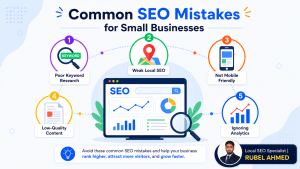
Small businesses can compete with larger brands when they implement smart, effective SEO strategies. Avoiding these common mistakes—ignoring local SEO, poor keyword strategy, mobile optimization issues, neglected on-page SEO, low-quality content, lack of analytics, poor link-building, and outdated content—can dramatically improve your online visibility.
If you want expert guidance to navigate the complex world of SEO, trust Local SEO Specialist | RUBEL AHMED to help your business grow online. With the right approach, your small business can attract more local customers, improve search rankings, and achieve lasting success.

I am Rubel Ahmed Professional SEO Expert & Consultant, I have a Experience Of Over 2 Years in Keyword Research,On Page Optimazation,Content Strategy.